Managing digital evidence has never been more complex, and the traditional methods are starting to reveal their limitations.
Files stored on shared drives. DVDs stacking up on shelves. Or maybe you already have a digital evidence management system that is no longer meeting your agency’s needs. If any of that sounds familiar, you are probably close to doing something about it.
Switching to a modern system is a meaningful move, and it is natural to have questions about cost, timeline, and adoption before you commit. This guide walks you through the process so you know what to expect at every stage.
Here is what the transition looks like in practice.
Why Agencies Make the Switch
Most agencies do not switch because of one dramatic failure. They switch because small problems accumulate until the cost of doing nothing becomes impossible to ignore.
The signs usually show up gradually. A case hits a complication because chain of custody documentation has gaps nobody can fully explain. An officer’s footage sits on a flash drive for months before anyone realizes it never made it into the system. A records request that should take a day turns into a week-long search across drives, inboxes, and filing cabinets.
Digital evidence management fixes these problems at the source. A centralized platform stores every file, whether that is body camera footage, dashcam video, photos, or documents, in one secure and searchable location. Every access gets logged automatically, every file gets a timestamp, and chain of custody maintains itself without anyone having to manage it manually.
The operational case is clear. The harder question is what getting there actually looks like.
Phase 1: Assessment and Planning
Every successful switch starts with an honest inventory. Before you move a single file, you need to know what you have and where it lives.
This phase brings together your IT team, patrol supervisors, detectives, and records staff to answer a few foundational questions about what types of digital evidence your agency collects most, where that evidence currently lives, and where your chain of custody documentation has gaps.
This is also when you choose your platform. Look for law enforcement evidence management software built specifically for public safety rather than a generic file storage solution. Your platform should support your evidence retention schedules and deliver full audit trails from upload to deletion.
By the end of this phase, you should have a clear data migration plan and a realistic rollout timeline. From there, the technical setup begins.
Phase 2: System Setup and Data Migration
This is the phase where most agencies feel the most uncertainty, and where having the right implementation partner makes all the difference.
System setup covers configuring user roles and permissions and establishing your file naming conventions and metadata standards. Most platforms guide you through this with structured setup workflows, but your IT manager should stay actively involved throughout.
Data migration takes the most time, and the right vendor will guide you through it with a clear plan that keeps your current operations running without interruption. Getting this step right is what separates a smooth transition from a frustrating one.
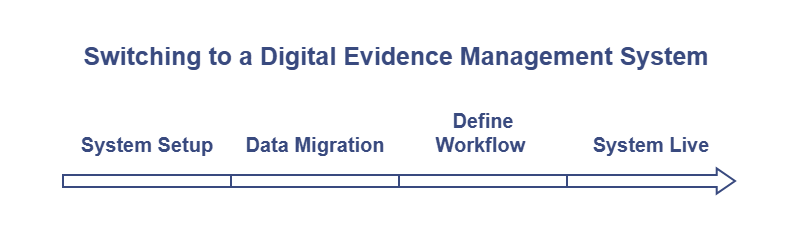
During migration, you will also define your ongoing intake workflows, including how officers upload body camera evidence and footage from the field and what happens when a file arrives without required metadata. Getting these standards right early prevents recurring problems down the road.
By the end of this phase, your system should be live with your evidence loaded and your intake process ready for daily use.
Phase 3: Getting Your Team Up to Speed
One of the biggest advantages of a modern digital evidence management platform is that it is built to be intuitive. Staff get comfortable quickly because the workflows mirror what they already do, just without the manual steps and paperwork that slow everything down.
Most users find their footing in the system quickly. For anyone who runs into questions, VeriPic’s support team is available to help directly so nobody is left to figure things out on their own after go-live.
There will be a short adjustment period as your team builds new habits, but most agencies find that adoption happens faster than they expected once staff sees how much easier their day-to-day work becomes.
Phase 4: Go-Live and the First 90 Days
Go-live is the starting line for continuous improvement, not the finish line.
In the first 30 days, focus on intake compliance. Are officers uploading footage within the required timeframe? Are files getting properly tagged with case information? Catching outliers early gives you the chance to correct course before patterns become habits.
Between days 30 and 60, shift your attention to measuring time savings. How much time are officers saving on evidence documentation per shift? How quickly can investigators retrieve and share files compared to before? If your agency uses VeriPic’s Digital Forensics Suite, this is also a good time to evaluate how FFT analysis and advanced forensic tools are fitting into your investigators’ workflows.
By day 90, you should have enough real data to evaluate your ROI and identify where to focus next, whether that means expanding to a new unit or deepening how your team uses the platform’s more advanced capabilities.
Your vendor should remain actively involved throughout this period. Regular check-ins and responsive support are the signs of a partner invested in your long-term success.
Keys to a Smooth Transition
The agencies that get the most out of this switch share a few things in common, and it is worth keeping them in mind as you plan.
Choosing chain of custody software built specifically for law enforcement makes a significant difference. A platform designed for public safety understands the compliance requirements, evidence retention rules, and documentation standards that a generic tool simply was not built to handle.
Treating the transition as an ongoing discipline rather than a one-time project also matters. The agencies that keep refining their workflows, training new staff properly, and using the platform’s full capabilities are the ones that see the greatest long-term return.
The Bottom Line
Switching to digital evidence management is a meaningful operational change, but it is far less disruptive than most agencies expect and the benefits show up quickly. Administrative work gets lighter, chain of custody documentation gets stronger, and investigators have better tools at their fingertips when cases demand it.
The agencies that make this switch rarely look back. The question is not whether to modernize. It is whether you can afford to keep waiting.
VeriPic has helped law enforcement agencies of all sizes make this transition since 1998. If you want to see how the process works for an agency like yours, request a demo today.