An evidence management software evaluation is one of the highest-stakes purchasing decisions a law enforcement agency makes. The wrong vendor can compromise the chain of custody and stall data migrations. They can lock your agency into a contract that fails to deliver. Before the demo stage, review the complete guide to evaluating evidence management software to build your framework first.
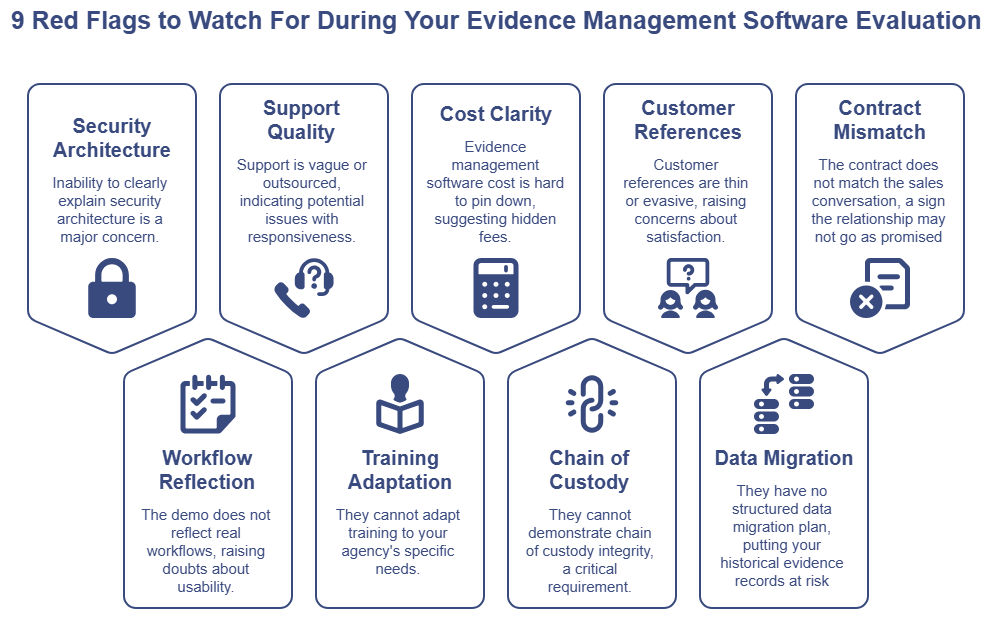
Many of these problems are avoidable. They show up as warning signs during the evaluation process if you know where to look. Here are the nine red flags that agencies most often miss before committing to a digital evidence management system.
1. They Cannot Clearly Explain Their Security Architecture
A vendor should be able to tell you where your data lives, how it is protected, and who can access it. Vague answers about encryption, access controls, or server locations are a warning sign. The explanation does not need to be a deep technical briefing, but it should be specific.
Ask where data is physically stored. Ask whether the vendor uses government-certified cloud infrastructure, such as Microsoft Azure for Government. Ask what happens to your data if you cancel your contract. If answers are inconsistent, take note.
Agencies handling criminal evidence cannot afford ambiguity around data security. A vendor that struggles in sales conversations will struggle even more when something goes wrong in production.
2. The Demo Does Not Reflect Real Workflows
Vendors often build demo environments that look polished but do not reflect real agency conditions. Watch for demos that skip common tasks. Watch for environments that load suspiciously fast. Watch for representatives who steer around certain features mid-demo.
Go in with a prepared list of questions. The 10 questions to ask during a demo cover workflows, storage, audit trails, evidence sharing, and vendor support. Ask to see a live environment instead of a scripted walkthrough. Ask to speak with a current customer at a similar agency. A vendor confident in their product will make that happen.
3. Support Is Vague or Outsourced
When evidence needs to be secured for court, and the system goes down, you need help fast. Find out who answers the phone when something breaks. Ask whether your agency gets a named support contact or a general help desk. Confirm that response-time commitments are included in the contract.
Some vendors rely on third-party partners for support. That is not a dealbreaker on its own, but it adds layers that slow resolution times. Know what you are getting before you need it. Ask to see support resolution data from other agencies to verify the vendor’s claims.
4. They Cannot Adapt Training to Your Agency’s Needs
Support and training are separate concerns. Support covers what happens when something breaks. Training covers what happens when your staff needs to use the system from day one.
Ask the vendor how they approach training. Ask whether they tailor it to your workflows or deliver a generic walkthrough. Ask what happens when staff turns over and new officers need to get up to speed. A vendor that cannot adapt to your setup puts the burden on your team. That creates inconsistency in how evidence gets handled across the agency.
5. Evidence Management Software Cost Is Hard to Pin Down
Evidence management software cost structures vary widely. Some vendors charge per user. Some charge per gigabyte of storage. Some bundle features that others charge for separately. Pricing complexity alone is not a red flag. A vendor who cannot give you a clear, itemized breakdown is a different story.
Ask for a multi-year projection. It should account for storage growth, additional licenses, and future expansion. Ask what happens to pricing if your agency grows. Ask whether rates are locked at renewal. Year-two and year-three surprises are among the most common complaints during the evidence management software evaluation process.
6. They Cannot Demonstrate Chain of Custody Integrity
Chain of custody protection is a core function of any digital evidence management system. The platform should log every action taken on a file. It should document who accessed it, when, and what changed.
Ask the vendor to walk you through an audit trail during the demo. Ask whether the trail is tamper-evident. Ask whether investigators can pull audit logs without IT involvement when they need them for court. Ask what happens to audit records if a file is deleted. Uncertainty about how that data is stored is a meaningful gap in any evidence management system.
7. Their Customer References Are Thin or Evasive
References matter more in law enforcement technology than in most other software categories. Your agency is trusting this vendor with evidence that affects criminal cases, officer records, and public safety outcomes.
Ask for references from agencies that match your size and jurisdiction. Ask for agencies that completed a migration with this vendor, then call them. Ask what went wrong during implementation, not just what went right. Ask whether they would choose the same vendor again. Vendors who perform well will have customers who speak candidly, even about the hard parts.
8. They Have No Structured Data Migration Plan
Switching digital evidence management systems means your historical data has to come with you. Ask the vendor to explain the migration process. Ask who maps your existing file structures and metadata to the new platform. Ask what happens if records do not transfer cleanly.
A vendor with real migration experience will have a clear methodology. They will assess your current setup early. They will give you a timeline, a testing phase, and a rollback plan. If migration feels like an afterthought in the sales conversation, expect the same in practice.
9. The Contract Does Not Match the Sales Conversation
Read the contract before signing. Features presented as standard during the demo sometimes turn out to be add-ons. Support response times promised verbally may not appear in the service level agreement.
Have your legal team review terms around data ownership, portability, and termination. Make sure you can retrieve your data in a usable format if you leave. Anything a vendor tells you that affects your decision should be in writing. If they will not put it in the contract, that tells you something about how the relationship will go.
A thorough evidence management software evaluation takes time, but pressing vendors on these nine points will tell you far more than any sales pitch. The vendors worth working with will welcome the scrutiny.
Next step: Use the Evidence Management Software Evaluation Scorecard to score vendors side by side across security, chain of custody, support, and pricing criteria. Download it free and bring it into your next vendor conversation.