Making a case for new software does not have to be complicated. The value of digital forensics software is evident in real, measurable ways: faster case turnaround, improved documentation, and more time for examiners to focus on analysis. The challenge is knowing how to quantify it. This post gives you a framework to do exactly that.
Why ROI Is Harder to Calculate in Forensic Labs
Most ROI calculations look at revenue generated or costs saved. Forensic labs don’t sell products. They produce results. That changes how you measure value.
ROI in a forensic context often comes down to three things:
- Time saved per examiner per case
- Reduction in errors or rework
- Quality and defensibility of case output
None of these show up cleanly in a spreadsheet. But they absolutely show up in your unit’s performance over time.
The good news is that these metrics are trackable, providing administrators with a framework to build a real cost-benefit case.
The Hidden Cost of Manual Workflows
Before calculating what forensics software saves, it helps to calculate what manual workflows cost.
A latent print examiner working without dedicated digital tools spends time on tasks that have nothing to do with analysis. Exporting images from one system, reformatting files, documenting steps in separate logs, and annotating prints by hand are real time costs per case.
Now multiply that by case volume. A mid-sized forensic unit might process hundreds of cases per month. If an examiner loses 30 to 45 minutes per case to workflow friction, the hours add up fast.
That time is not free. It represents a real cost in labor, capacity, and opportunity. Cases that should take two days take four. Backlogs grow. Examiners burn out.
Software designed around the latent print workflow removes that friction. Examiners spend more time on the analysis itself, which is what your agency is actually paying them to do.
Where Digital Forensics Software Creates Measurable Value
Software ROI shows up in specific, tangible places. Here is where to look.
Case Turnaround Time
When examiners work in a single integrated system, uploading, analyzing, annotating, and documenting in one place, case time drops. Instead of switching between tools and manually transferring data, they move through the workflow without interruption.
Faster turnaround means more cases closed per month. For agencies managing high caseloads, that alone can justify the cost of the software.
Audit Trails and Documentation
Courts expect documentation. Defense attorneys look for gaps in the chain of custody and inconsistent records. Manual documentation creates those gaps.
A digital forensics platform with built-in audit trail logging captures file activity automatically. Every time a file is opened or saved, the system records it. That record is available in court when it is needed most. Learn more about how audit trails work in digital evidence management.
This kind of built-in accountability reduces the administrative burden on examiners and strengthens the agency’s position in legal proceedings.
Image Quality and Enhancement Accuracy
Low-quality latent prints are a fact of forensic work. Enhancing them takes skill and the right tools. General-purpose photo editing software was not built for forensic image analysis. It lacks the precision, the non-destructive workflow, and the scientific documentation that forensic work demands. See how forensic image enhancement software differs from general-purpose tools.
Purpose-built latent print software gives examiners tools designed for forensic enhancement: FFT filtering, channel analysis, brightness and contrast adjustments, and annotation layers, all applied non-destructively. The original image is never altered. Read the full comparison of digital vs. manual latent print analysis.
Better tools produce better enhancements. Better enhancements lead to more identifications. More identifications close cases. The downstream value of that is difficult to overstate.
Training and Onboarding
Software built around a familiar forensic workflow is easier to learn. When your platform aligns with the workflow examiners already follow, new users get up to speed faster. Experienced examiners don’t have to re-learn how to do their jobs.
Reduced training time is a direct cost savings. A system that takes two weeks to learn instead of two months returns the examiner to full productivity much faster.
Calculating the Cost of Inaction
One of the most overlooked parts of any ROI conversation is the cost of not investing.
If your unit continues with manual workflows, what is the ongoing cost? Calculate the average time lost per examiner per case. Multiply that by the number of examiners and the average monthly caseload. Assign an hourly labor rate.
That number represents the annual cost of staying with the current system.
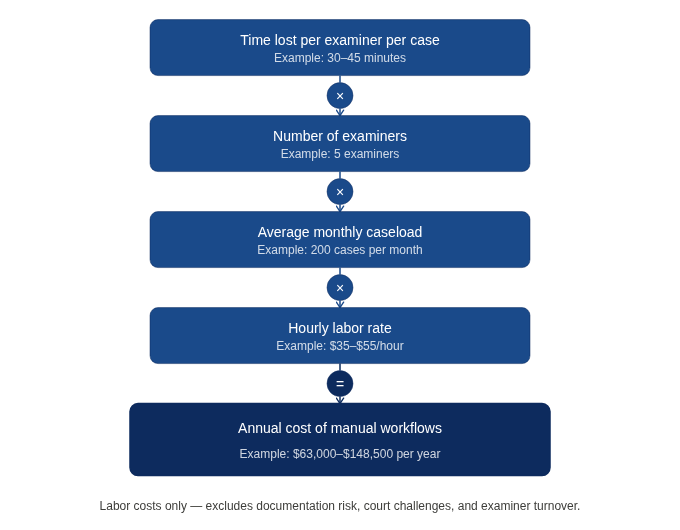
Use this framework to estimate what manual workflows cost your unit each year. Multiply the time lost per examiner per case by your team size, monthly caseload, and hourly labor rate. The result is a baseline labor cost, before factoring in documentation risk, court challenges, or examiner turnover.
Now add the less quantifiable costs: documentation risks, potential court challenges, recruiter costs when burned-out examiners leave, and the reputational impact of delayed case closures on your agency.
The cost of inaction is rarely zero. In many cases, it is higher than the cost of the software itself.
What to Look for When Comparing Platforms
Not all digital forensics software delivers the same ROI. Evaluating platforms on the right criteria helps ensure the investment pays off. The Complete Guide to Digital Forensics Software for Law Enforcement covers the full landscape. This section focuses on the criteria that matter most for ROI.
Integration with existing systems. A forensics platform that works alongside your existing digital evidence management system reduces friction and data silos. Look for solutions where image analysis and case management share the same environment.
Non-destructive processing. Any enhancement to a latent print image needs to be reversible and documented. A platform that applies changes as adjustment layers, without altering the original file, protects the integrity of your evidence.
Audit trail capability. The platform should log file activity automatically. Examiners should not need to maintain separate logs to meet documentation standards.
Scalability. Your unit’s caseload will grow. The platform should scale with it. Evaluate licensing structures, multi-user access, and administrative controls before committing.
Vendor support. A platform is only as reliable as the team behind it. Look for vendors with a track record in law enforcement, responsive support, and a history of regular software updates.
Building the Business Case for Your Agency
When it is time to present the investment to leadership, frame the conversation around outcomes, not features.
Start with the problem: manual workflows cost examiner time, create documentation risk, and limit case throughput. Then present the solution in terms of what changes.
Use real numbers where possible. Estimate time saved per case. Project the impact across your unit’s caseload. Show what that means for case turnaround and annual examiner capacity.
Then address the risk side. What happens if a case is challenged because the documentation is incomplete? What does it cost to defend that challenge? What does it cost if the agency loses?
A compelling business case does not just sell the software. It sells the risk reduction and operational improvement that the software enables.
The Bottom Line
Digital forensics software is not a luxury purchase. For agencies serious about case quality, examiner efficiency, and court-ready documentation, it is an operational necessity.
The ROI is real. It just requires the right framework to measure it. Calculate what manual workflows cost today. Project what a purpose-built platform saves. Then compare those numbers against the cost of the software.
For agencies managing meaningful caseloads, the math tends to be straightforward.
VeriPic’s Digital Forensic Suite integrates directly with the Digital Evidence Manager platform, giving latent print examiners a single environment for upload, analysis, annotation, and documentation. It is built around the forensic workflow, not adapted from it.
If your unit is evaluating digital forensics software, request a demo and see how the platform fits your workflow and your budget.