A latent print examiner lifts a partial print from a crime scene. It’s a solid piece of evidence. But before it ever reaches a courtroom, it has to pass through a documentation process that, in many agencies, still relies on disconnected tools, manual logs, and shared network drives held together by institutional habit.
Cases get complicated not due to the examiner’s skill, but because their systems weren’t built for their work.
Digital forensics software exists to fix that. It brings the forensic workflow into a single, controlled environment where evidence is managed, analyzed, and documented in a way that holds up under the most demanding scrutiny. For law enforcement agencies, that’s not a technology upgrade. It’s a case integrity decision.
This guide covers what digital forensics software is, what it needs to do, and how to evaluate platforms that are actually built for the realities of law enforcement forensic work.
What Is Digital Forensics Software?
Digital forensics software is a technology platform that enables law enforcement professionals to collect, store, examine, annotate, and document forensic evidence in a secure digital environment.
The term covers a wide spectrum. On one end, you have specialized tools built for a single task. On the other end, you have comprehensive platforms designed to support entire forensic disciplines from intake to final report.
For agencies focused on physical evidence examination, and specifically for latent print examiners, the most relevant category is the unified forensic platform. This type of software is built to support the full examination workflow in one place. Examiners upload evidence, conduct their analysis, document their findings, and generate reports without ever leaving the system.
That matters because the alternative is fragmentation. Most agencies that haven’t adopted a unified platform are running some version of the same patchwork: one application for image processing, another for annotation, a case management system that doesn’t communicate with either, and a separate forensic reporting platform that requires manual data entry to produce a final report. Every handoff between those systems is a liability.
The shift toward all-in-one forensic software isn’t just about convenience. It’s about the integrity of the evidence and the defensibility of the documentation that follows it.
The Forensic Evidence Lifecycle: Where Software Plays a Role
To understand what digital forensics software should do, it helps to map it against the actual lifecycle of forensic evidence in a law enforcement context.
Collection and intake is where evidence enters the system. In a digital environment, this means uploading images, files, or data into a secure platform with an immediate, automatic record of when the evidence was received, by whom, and in what condition. Manual intake logs introduce the possibility of error at the very first step.
Examination and analysis is where the examiner’s expertise comes in. For latent print examiners, this phase involves assessing print quality, identifying ridge detail, and making initial determinations about the value of the evidence. The software needs to support this work without getting in the way. High-resolution image viewing, enhancement tools, and a clean interface that mirrors how examiners think about their work are all baseline requirements.
Documentation and annotation runs parallel to analysis. Every observation, every mark, every conclusion needs to be recorded as the work happens. Why Documentation Defines Forensic Success goes deeper on why this step is the difference between solid casework and a compromised record. In a purpose-built platform, documentation happens inside the same environment where the analysis takes place. In a fragmented workflow, examiners export images, annotate them in a separate tool, and manually re-associate those files with the case record. That process introduces version control risks and chain of custody questions that are difficult to answer cleanly in court.
Comparison is central to disciplines like latent print examination. The examiner needs to place the unknown latent print alongside a known exemplar and document the basis for any identification or exclusion. Software that supports this phase provides side-by-side viewing, overlay tools, and zoom functions that allow the examiner to work precisely and document every comparison point.
Verification is the checkpoint. In latent print examination, a second examiner independently reviews the evidence and the first examiner’s findings before any conclusion is finalized. A unified platform supports this by giving the verifying examiner access to the complete case record, including the original evidence, the annotations, and the comparison notes, without requiring the first examiner to manually package and transfer that information.
Reporting is the output. The final report needs to be clear, structured, and directly tied to the documentation produced during examination. Platforms that generate reports from within the system eliminate the risk of transcription errors and ensure that what the examiner submits to court is an accurate reflection of what they documented during their analysis.
Software that supports all six of these phases in a single environment isn’t just efficient. It’s the foundation of a forensic workflow that can withstand cross-examination.
Core Capabilities of Modern Digital Forensics Software
Understanding the evidence lifecycle makes it easier to evaluate specific platform capabilities. Here is what modern digital forensics software should deliver.
Secure evidence upload and storage. Files need to be ingested into a controlled environment with restricted access, automatic version tracking, and no ability to alter original evidence. Any platform that allows modification of source files without a clear audit trail is a liability.
Built-in image analysis and enhancement tools. For latent print examination specifically, the platform needs to support image-level work without requiring examiners to use a separate application. Brightness, contrast, and filtering adjustments should be available within the examination environment.
Annotation and markup. Examiners need to mark ridge characteristics, document comparison points, and add notes directly on the evidence image. These annotations need to be tied to the case record automatically, not saved as separate files that have to be manually re-linked.
Evidence integrity tracking. Every action taken on a piece of evidence should generate an automatic, tamper-evident log. Who accessed the file, when, what they did, and what the outcome was. This is non-negotiable in law enforcement contexts where evidence admissibility depends on a clean, unbroken record.
Multi-examiner workflow support. Forensic examination rarely happens in isolation. Platforms need to support sequential review, where one examiner completes their work and a second examiner picks up from that exact point, without requiring manual handoffs or file transfers.
Court-ready reporting. The platform should generate structured, professional reports directly from the examination record. Reports that require manual reformatting or data re-entry after the fact introduce unnecessary risk.
Role-based access controls. Not everyone in an agency should have the same level of access to forensic evidence. The platform should support granular permission settings that align with agency policy and data security requirements.
These capabilities define what a professional-grade digital forensics platform looks like. Agencies evaluating software should treat any gaps in this list as a significant risk factor.
Why Latent Print Examiners Need Purpose-Built Software
Latent print examination is one of the most documentation-intensive disciplines in forensic science. The ACE-V methodology, the standard framework for latent print analysis, requires examiners to produce a clear, detailed record of their work at every phase.
ACE-V stands for Analysis, Comparison, Evaluation, and Verification. Each phase has specific documentation requirements, and the integrity of the process depends on those requirements being met consistently.
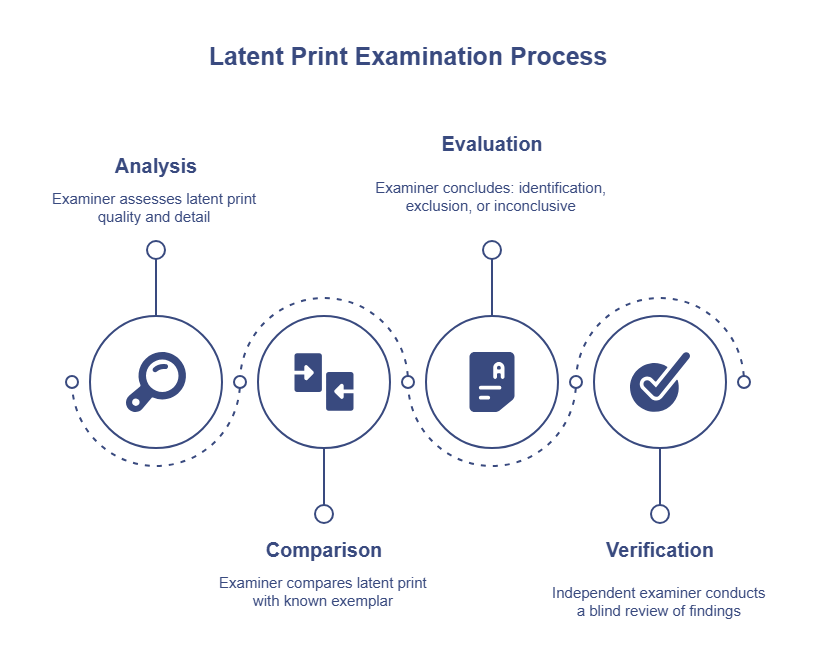
Analysis requires the examiner to assess the latent print in isolation before any comparison takes place. The examiner documents the quality of the print, the visible ridge detail, and a determination of whether the print has sufficient value to support an identification. Software that supports this phase captures those observations within the case record automatically.
Comparison requires the examiner to place the latent print alongside a known exemplar and systematically document the points of similarity or difference. Annotation tools that allow examiners to mark corresponding features on both images, within the same platform on the same screen, make this phase faster and more defensible.
Evaluation is where the examiner reaches a conclusion: identification, exclusion, or inconclusive. That conclusion, and the documented basis for it, needs to be captured in a way that a verifying examiner and, eventually, a court, can follow clearly.
Verification requires an independent examiner to conduct their own ACE-V review without being influenced by the first examiner’s conclusions. A properly designed platform supports blind verification. The verifying examiner can access the evidence without seeing the first examiner’s findings until after they have documented their own.
Legacy workflows were never designed around these requirements. Examiners adapted their process to fit the tools available. A purpose-built digital forensics platform inverts that relationship. The tools adapt to the process.
The Real Cost of Fragmented Forensic Workflows
The case for unified digital forensics software isn’t just about efficiency. It’s about risk management.
When chain of custody is maintained in a spreadsheet instead of an automated log, it becomes a target in court. For a closer look at how this plays out in practice, Inside the Digital Chain of Custody breaks down exactly what a defensible custody record looks like.
Defense attorneys are trained to find these gaps. A question as simple as “Can you confirm that this image has not been altered since it was collected?” becomes difficult to answer confidently when the evidence passed through three separate applications before landing in the final report.
There is also the human cost. Examiners are specialists. Their expertise is in analysis, not file management. Every hour spent navigating disconnected systems, manually documenting steps, and reconciling files across platforms is an hour not spent on casework. For agencies managing high case volumes, that time adds up quickly.
And then there is the training burden. Every additional tool in the workflow is another system to learn, another interface to maintain, and another point of failure when staff turns over.
If any of this sounds familiar, 5 Signs Your Agency Needs a Digital Evidence Management System is worth a read. A unified forensic platform consolidates that risk. One system to learn. One evidence trail to maintain. One platform to support.
Key Considerations When Evaluating Digital Forensics Software
Selecting a digital forensics platform is a significant operational decision. These are the factors that separate platforms that deliver long-term value from those that create new problems.
Purpose-built vs. adapted. Some platforms on the market started as commercial imaging or document management tools and were modified for law enforcement use. Others were built from the ground up for forensic examiners. The difference is visible in the workflow. Purpose-built platforms reflect how examiners actually work. Adapted platforms ask examiners to work around the software’s original design.
Ease of use for examiners. Adoption rates drop when interfaces are unintuitive. Evaluate platforms by putting them in front of the examiners who will use them daily, not just the IT staff who will implement them.
Security and data compliance. Law enforcement agencies operate under strict data governance requirements. The platform needs to meet applicable standards for evidence data security, access control, and audit logging.
Scalability. A platform that works for a five-person forensic unit needs to scale gracefully when case volume increases or the agency expands. Evaluate architecture and licensing models with growth in mind.
Vendor expertise in law enforcement. Technical support is only as useful as the team providing it. Vendors with direct experience supporting forensic labs and law enforcement agencies understand the stakes. Those without that background often don’t.
Implementation and training support. The platform is only as effective as the rollout. Look for vendors who provide structured onboarding, training resources built for forensic practitioners, and ongoing support that goes beyond a ticketing system.
What a Purpose-Built Digital Forensic Suite Looks Like in Practice
The best digital forensic suites share a defining characteristic: the workflow is built into the software, not bolted on after the fact.
That means upload, annotation, comparison, verification, and reporting all live in a single environment. It means chain of custody documentation happens automatically, not because an examiner remembered to fill in a log. It means the second examiner in a verification workflow has everything they need without the first examiner having to package and hand off a folder of files.
VeriPic’s Digital Forensic Suite was built with exactly this workflow in mind. It gives latent print examiners a single platform to upload, mark, annotate, and analyze prints, with documentation and chain of custody tracking built into every step. No switching between tools. No manual logging. The system supports the examiner’s process instead of adding to it.
For agencies evaluating their forensic software options, the question isn’t whether to modernize. The question is which platform is actually built for the work.
The Bottom Line
Digital forensics software is foundational infrastructure for any law enforcement agency that takes evidence integrity seriously. The agencies producing reliable, court-ready forensic documentation are the ones that have moved beyond fragmented tools and manual workflows.
The cost of staying with legacy systems isn’t just operational inefficiency. It’s case risk. It’s examiner time spent on the wrong problems. It’s chain of custody questions that shouldn’t exist.
A purpose-built Digital Forensic Suite eliminates those risks by design. The workflow is the system.
See what VeriPic’s Digital Forensic Suite can do for your team. Request a demo today.