Every crime leaves a trail. The question is whether your tools are good enough to follow it.
Digital forensics is the use of scientific methods to collect, preserve, analyze, and present evidence using digital tools and workflows. The word “digital” describes the process, not always the evidence itself. A latent print lifted from a door frame is still a physical artifact. But the moment an examiner processes it inside a digital system, the technique becomes digital forensics.
That distinction matters. And for law enforcement agencies still relying on analog workflows, it’s the difference between evidence that holds up in court and evidence that doesn’t.
The Problem with How Things Used to Work
Historically, latent print examinations relied on paper, film, and physical case files. Examiners lifted prints, documented findings by hand, and transferred physical evidence between departments. While the science was strong, the infrastructure could not keep up.
Files were sometimes misplaced. Documentation varied among examiners. When defense attorneys challenged methodologies, complete records were often missing. With growing caseloads, shortcomings in analog workflows became more evident.
Caseloads continue to increase. Staffing has not kept pace. Examiners are required to process more evidence, document more thoroughly, and face greater scrutiny, often with the same longstanding tools. Change has become necessary.
What Digital Forensics Actually Solves
Digital forensics tools don’t just move the workflow onto a screen. They change what the workflow can do.
When an examiner uploads a latent print into a digital forensic platform, the original file is preserved exactly as it was captured. Annotations layer on top, they never alter the source. Every mark is timestamped. Every action is logged by the examiner who made it. The result is a record that is complete, auditable, and traceable from collection to conclusion.
That kind of documentation does something analog methods can’t: it makes the examiner’s methodology visible. Supervisors can review it. Courts can evaluate it. And when findings get challenged, there’s a full record to stand behind, not just a conclusion.
Chain of custody, which has always been the backbone of admissible evidence, becomes a byproduct of the workflow rather than a separate administrative burden.
Admissibility Depends on the Process, Not Just the Findings
Courts don’t just evaluate what an examiner found. They evaluate how they found it.
For digital forensic evidence to be admissible, it needs to meet a consistent standard: authentic, complete, collected using validated methods, and legally obtained. That standard applies whether the evidence is a hard drive or a latent print lifted from a crime scene.
Agencies using disconnected tools, one application for image enhancement, another for annotation, a third for reporting, introduce risk at every handoff. When evidence moves between systems, record gaps open up. And a single gap in the chain of custody can break down an otherwise airtight case.
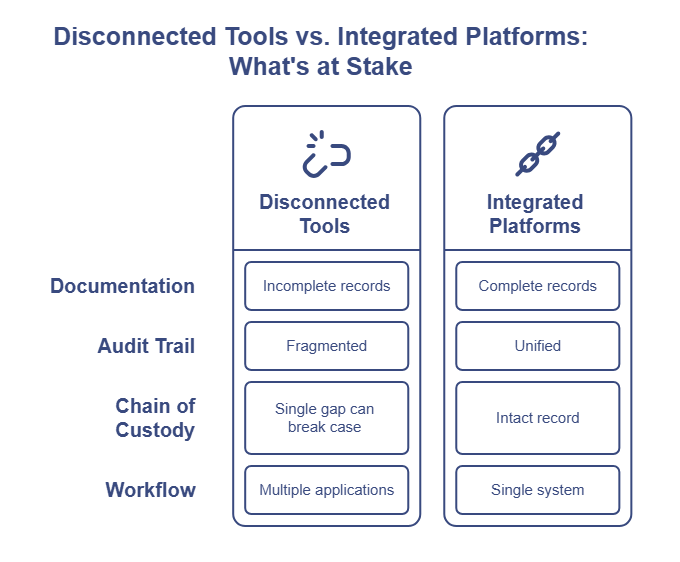
This is why the industry has shifted toward integrated forensic platforms. When the entire examination workflow lives in a single system, documentation is continuous. Nothing gets exported, converted, or re-uploaded. The record stays intact from the first upload to the final report.
What This Means for Latent Print Examiners
For latent print work specifically, integrated digital forensic software is a structural upgrade, not simply a convenience.
Examiners work in a single environment that handles uploading, marking, annotating, and analyzing prints from start to finish. There’s no switching between tools. No manual re-entry. No version control problems when a file gets updated. The workflow is cleaner, and the documentation is stronger as a result.
VeriPic’s Digital Forensic Suite was built around this model. It centralizes the entire latent print examination workflow, uploading, processing, annotating, and analyzing, into a single platform. The system streamlines tasks, keeps data secure, and automatically tracks every action, making examiners more efficient and confident in their casework.
Why Agency Leadership Should Care
The case for digital forensics isn’t just operational. It’s strategic.
Agencies that invest in modern forensic tools build stronger cases, reduce exposure to evidentiary challenges, and give examiners a better foundation to work from. Transparent methodology and automatic documentation put an agency in a stronger position, both in court and in the court of public opinion.
There’s a talent angle too. Skilled latent print examiners are in high demand. Agencies with up-to-date tools attract better candidates and make it easier to bring new examiners up to speed. A well-designed platform shortens the learning curve and reduces process errors before they become problems.
The Direction Things Are Heading
Digital forensics will keep evolving. Machine learning is beginning to assist with pattern recognition in latent print analysis. Cloud-based platforms are making cross-jurisdictional collaboration easier. Courtroom standards around digital documentation will only get more rigorous.
Agencies building on integrated forensic infrastructure now are ahead of that curve. Those still patching together disconnected tools are accumulating risk, and eventually, that risk shows up in case outcomes.
Digital forensics isn’t about replacing the expertise of a trained examiner. It’s about giving that expertise the infrastructure it deserves, so agencies can deliver stronger, more defensible results for every case, now and as technology advances.
Ready to upgrade your workflow? Request a demo of VeriPic’s Digital Forensic Suite and see the full latent print examination process in action.