Every law enforcement agency faces the same challenge: managing massive volumes of evidence while trying to find specific files quickly when they matter most.
A typical robbery investigation generates 50-200 individual evidence files: body cam footage from multiple officers, crime scene photos, witness interviews, surveillance video from three different businesses, screenshots from social media, phone records, and written reports, all uploaded by different officers over several weeks as the investigation develops.
When you multiply that across 40 active cases, you’re looking at thousands of evidence files. Finding the specific piece you need becomes the challenge, not whether you collected it in the first place.
Why Traditional File Storage Can’t Keep Up
A decade ago, case files meant manila folders with photos and paperwork. Today’s investigations generate gigabytes of digital evidence before officers even leave the scene, and traditional storage systems weren’t built to handle this volume or complexity.
Network drives, shared folders, and external hard drives were designed for documents and spreadsheets. They struggle with hundreds of video files, thousands of photos, and investigations involving multiple officers contributing evidence over weeks or months.
The problems compound quickly. Evidence gets saved wherever is convenient at the time. File naming conventions vary depending on who’s uploading and when. That carefully organized folder structure that worked perfectly for your first 20 cases becomes nearly impossible to navigate by case 40.
The real cost shows up in wasted time. Investigators spend hours each week hunting for evidence they know exists but can’t quickly locate. That’s time that should go toward actual investigative work, not digital file management.
The fundamental issue isn’t poor organization, it’s that traditional file systems force you to remember where something is stored rather than what it actually contains. Investigators don’t think in terms of folders and file paths. They think about cases, suspects, locations, and types of evidence. When your storage system can’t match how you actually work, finding evidence becomes unnecessarily difficult.
How Evidence Management Systems Actually Work
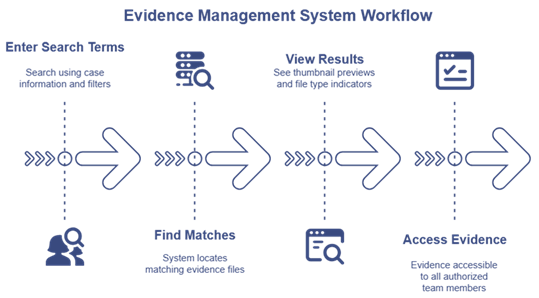
Modern evidence management systems replace folder navigation with database search. Instead of clicking through directory structures hoping to find what you need, you search using the information that actually matters to your investigation.
Evidence management systems let you combine multiple search criteria simultaneously. Search by case number to pull everything related to a specific investigation. Filter by date range to find evidence collected during particular timeframes. Search keywords in case descriptions and notes to locate specific details you documented weeks ago, and more. These search capabilities work together, allowing you to narrow results to exactly what you need in seconds.
The visual component makes a significant difference as well. Rather than opening file after file to see what each contains, you can scan thumbnail previews of images and videos directly in the search results. Documents, audio files, and PDFs display clear file type indicators so you know what you’re looking at before clicking anything.
Perhaps most importantly, evidence uploaded by any officer becomes immediately accessible to everyone with proper permissions. This eliminates the common problem of needing to track down whoever originally uploaded a file to ask where they saved it or what they named it. When evidence is properly documented in a centralized system, anyone authorized can find it.
How Fast Can You Find Evidence?
Consider how evidence management systems change common investigative tasks. A detective preparing for court testimony can search the case number and immediately see all related evidence displayed chronologically. She reviews crime scene photos, watches body cam footage, and reads witness statements, everything she needs to refresh her memory, all found and assembled in under two minutes.
When a detective suspects multiple burglaries might be connected, he can search by case type and date range to review photos and descriptions across all similar incidents. This kind of pattern analysis often reveals connections between cases that weren’t previously apparent, especially when different officers handled the investigations in different districts.
Discovery requests become dramatically more efficient as well. Instead of coordinating with multiple officers to track down files scattered across various storage locations, investigators can quickly search the case number, gather all evidence, and share it with the prosecutor’s office via e-discovery. Tasks that previously consumed hours now take minutes.
Why This Matters for Your Agency
The shift from folder-based storage to centralized evidence management systems fundamentally changes how law enforcement handles one of its most critical operational challenges. This isn’t just about adopting new technology, it’s about matching your evidence management tools to the way investigations actually work.
When evidence retrieval becomes faster and more reliable, everything else improves. Investigations move more quickly. Court preparation takes less time. Discovery requests get handled efficiently. Team coordination becomes smoother. Officers spend their time on police work instead of digital file management.
The volume and complexity of digital evidence will continue growing. Body cameras, surveillance systems, phone records, and social media evidence aren’t going away. Agencies that adapt their evidence management practices to meet these demands position themselves for operational success rather than constantly playing catch-up with mounting data challenges.