Why Manual Documentation Puts Your Cases at Risk
It only takes one missing timestamp for a defense attorney to dismantle a months-long investigation. A single gap in your digital evidence audit trail (who accessed a file, when it was transferred, whether it was modified) can render otherwise solid evidence inadmissible in court.
Yet many law enforcement agencies still document digital evidence chain of custody the same way they handled physical evidence in the 1990s: manual logs, shared drives, and hoping everyone remembers to document every action.
Here’s what chain of custody actually requires for digital evidence, why manual systems consistently fail, and how purpose-built digital evidence management systems solve these problems automatically.
Why Digital Evidence Chain of Custody Is Different
Physical evidence chain of custody is straightforward: an item moves from person to person, each transfer is documented, and the evidence remains sealed.
Digital evidence doesn’t work this way. A video file can be accessed by multiple people simultaneously, copied or modified without obvious signs, shared across networks in seconds, and stored in multiple locations at once.
Traditional paper documentation can’t capture the complexity of digital evidence handling. You need a system that automatically logs every interaction with the file from creation until it’s presented in court.
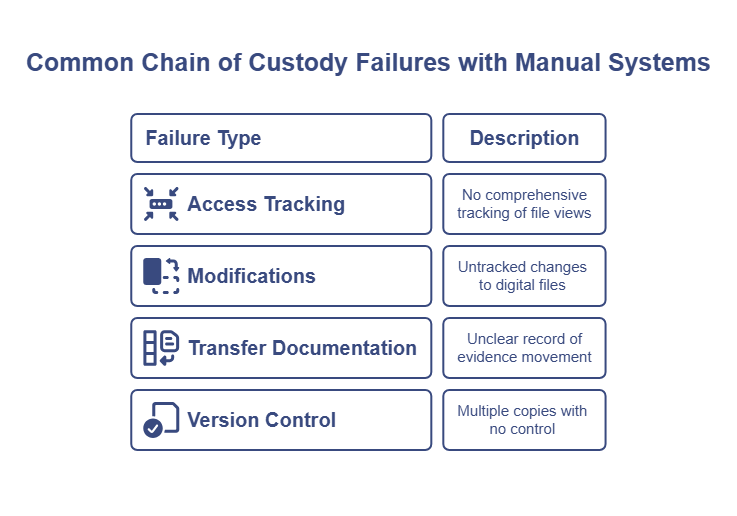
Common Chain of Custody Failures with Manual Systems
When agencies manage digital evidence using shared drives or basic file storage, several problems occur repeatedly:
No comprehensive access logs. Shared drives typically don’t track who viewed or copied a file, only who modified it. If ten people have folder access, you can’t prove who accessed specific files.
Untracked modifications. When someone edits a video file or renames a document, these changes often aren’t logged. There’s no record of what changed or why.
Unclear transfer documentation. Evidence moves from a body camera to a server, gets downloaded by a detective, copied to a DVD for the prosecutor. With manual systems, many transfers happen without any record.
Multiple copies with no version control. The same video exists on multiple devices and drives. If these versions differ, which one is authentic?
Learn more: Inside the Digital Chain of Custody
What Courts Actually Require
Courts evaluate digital evidence chain of custody based on whether you can demonstrate the evidence is authentic and unaltered. Most courts look for:
- Complete documentation of who collected, stored, accessed, and transferred the evidence
- Proof of integrity through technical controls and procedural safeguards that prevent unauthorized modification
- Access controls limiting who can view, modify, or delete evidence
- Audit trails showing every action with timestamps and user identification
- Secure transfer procedures that are documented and encrypted
Manual systems struggle because they rely on people to remember to document every action. Digital evidence management systems meet these requirements automatically.
How Digital Evidence Management Systems Solve This
Purpose-built systems automate chain of custody completely:
Automatic logging. Every action is logged the moment it occurs: uploads, views, downloads, shares. When an officer uploads body cam footage, the system records the file details, officer’s identity, timestamp, and source device. No manual documentation required.
Role-based access. Users only access evidence relevant to their role and cases. A patrol officer can upload but can’t delete. A detective can view assigned cases but can’t access unrelated investigations. Every action is logged.
Complete audit trails. Once logged, actions can’t be edited or deleted. Every modification is recorded, creating a permanent, tamper-proof record.
Version control and integrity protection. Systems track every version of a file, preserving the original while documenting any subsequent modifications. If a file is modified, the system creates a new version while maintaining the original. Access controls prevent unauthorized changes, and the complete version history remains part of the chain of custody record.
Secure sharing with tracking. Systems provide secure links with time-limited access and complete audit trails. You control who can view, download, or share evidence, and the system maintains a record of who was granted access and when.
See common mistakes to avoid: 5 Common Discovery Mistakes and How to Avoid Them
The Real Cost of Inadequate Chain of Custody
When chain of custody documentation fails:
- Evidence gets excluded because prosecutors can’t prove it wasn’t altered
- Cases proceed without critical evidence or get dismissed entirely
- Defense attorneys use incomplete documentation to question officer credibility
- Agencies spend more time in hearings addressing chain of custody challenges
The cost of lost cases and excluded evidence far exceeds the cost of implementing proper systems.
Conclusion
Digital evidence management systems remove human error by making chain of custody automatic. The system documents everything without requiring officers or staff to remember anything.
If your agency relies on manual chain of custody documentation, you’re not alone. Most agencies started with shared drives and paper logs because that’s what was available. But as digital evidence volume has exploded, those systems have become legal liabilities rather than solutions.
The good news? Modern digital evidence management systems handle chain of custody automatically, creating court-ready documentation without adding work for your officers or staff. The evidence you collect makes it to court with the proof of authenticity prosecutors need.
Related: 5 Signs Your Agency Needs a Digital Evidence Management System