Latent prints rarely land on clean, smooth surfaces. Patterned backgrounds, fabric weave, currency security features, and corrugated textures all compete with friction ridge detail. Fast Fourier Transform (FFT) filtering is one of the most effective tools in latent print software for suppressing repetitive background interference so examiners can access Level 2 detail (bifurcations and ridge endings) that would otherwise remain buried in noise.
FFT sits in the Analysis phase of ACE-V, one step in a broader latent print workflow that runs from evidence intake to courtroom-ready results. Its job is to improve image quality enough to make a meaningful comparison attempt possible. Understanding what it does well and where it falls short is what makes it useful in casework.
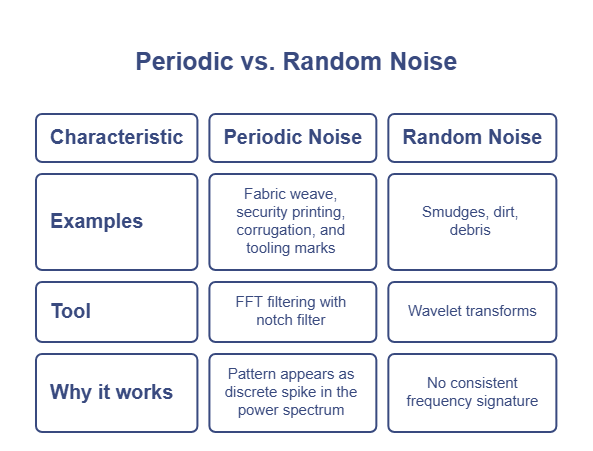
What FFT Does and Does Not Fix
FFT targets periodic noise: repeating, predictable patterns like fabric weaves, printed security lines, or machined tooling marks. It converts the image to the frequency domain, where those patterns appear as discrete spikes, often as symmetric pairs. Masking that spike pair with a notch filter, then converting the image back to the spatial domain, suppresses the interference while preserving underlying ridge detail.
It is not effective on random noise such as smudges, dirt, or uneven powder distribution. For random noise, other tools such as wavelet transforms are better suited. Gabor filters work differently. They enhance ridge structure aligned to expected ridge orientation rather than targeting specific noise frequencies. Using FFT on non-periodic noise can introduce artifacts if the filter is too broad or improperly placed. Over-suppression may remove genuine ridge information or introduce ringing artifacts that distort ridge structure. Examiners should always cross-reference the enhanced image against the original to confirm that no detail was created or lost in the process.
One more best practice worth noting: enhancement should be performed before viewing the known exemplar print. Marking features on the latent before comparison reduces the risk of cognitive bias influencing what the examiner perceives in the image.
FFT Before and After: Use Cases by Surface Type
The following use cases represent common substrates where FFT filtering in latent fingerprint software changes the outcome of the Analysis phase.
Use Case 1: Currency and Printed Documents
Security features on currency (intaglio lines, offset printing patterns, microprint) create dense, high-frequency periodic noise. Before FFT, the substrate interference obscures friction ridge detail to the point where the print lacks sufficient quality to proceed to comparison. The Level 2 detail needed to mark features is not accessible.
After FFT suppresses the repeating security pattern, ridge detail becomes visible across the deposit. The examiner can now mark bifurcations and ridge endings and proceed to the Comparison phase of ACE-V.
Best practice: Target the offset or intaglio printing frequency specifically. Broad suppression risks degrading the ridge detail you are trying to recover.
Use Case 2: Corrugated Cardboard and Packaging
Corrugation often occurs at a spatial frequency similar to fingerprint ridge spacing. Before FFT, the two sets of lines intersect and produce artifacts, distortions that complicate analysis and can cause an examiner to mark substrate lines as genuine ridge endings.
After FFT isolates and suppresses the corrugation frequency, the remaining detail is dominated by the deposit rather than the substrate. Ridge structure is now distinguishable from the background, and the examiner can proceed with confidence that marked features are real.
Use Case 3: Fabric and Textile Surfaces
A latent print developed on a woven surface carries the fabric’s grid as a second image overlaid on the deposit. Contrast adjustment and Gaussian filters do not suppress it selectively. Before FFT, the periodic noise from the weave dominates, and Level 2 detail is not accessible.
In the frequency domain, the weave appears as a discrete spike in the power spectrum, the visual plot the examiner sees when identifying what to mask. Identifying that specific spike before applying the notch filter, rather than suppressing a broad frequency range, preserves the most ridge detail. After FFT, the grid interference is substantially reduced, and the underlying friction-ridge structure becomes visible.
Use Case 4: Machined Metal Surfaces
Brushed aluminum, machined casings, and textured firearms carry consistent linear tooling marks. Oblique lighting at capture can minimize their effect, but on heavily textured surfaces the marks still compete with ridge detail in key zones.
The tooling lines register as a strong, narrow frequency band. FFT suppresses that band precisely. Zones previously blocked by the machined finish show sufficient Level 2 detail for a comparison attempt.
Best practice: Use oblique lighting before digital enhancement to reduce the amplitude of tooling marks in the raw capture. Less noise at capture means less correction needed in post.
How FFT Works Inside VeriPic® Digital Forensic Suite™
VeriPic® Digital Forensic Suite™ is latent print software built around the full ACE-V workflow. Examiners upload the latent print image directly into DFS, apply FFT filter controls to suppress the target frequency band, and mark features on the cleaned image, all in the same system. No export. No separate tool.
Every enhancement step is logged automatically. That log supports reproducibility, a principle explored in depth in Why Consistency Is the Cornerstone of Forensic Image Analysis. Another examiner can take the same raw image, apply the same documented steps, and arrive at the same result. That reproducibility helps make the workflow scientifically defensible in court proceedings. The documentation follows the print through the entire ACE-V process, from raw capture to marked comparison. For a broader look at how these tools fit together across the full evidence lifecycle, The Complete Guide to Digital Forensics Software for Law Enforcement is a good next step.