Every piece of evidence tells a story. But the way that evidence gets uploaded into your system shapes whether that story holds up in court.
For years, delayed upload was the only option. Officers collected evidence in the field, returned to the station, and manually transferred files to a server or shared drive. It worked. Until it didn’t.
Today, real-time upload is changing how departments handle digital evidence. And the gap between the two approaches is wider than most agencies realize.
What Delayed Upload Actually Looks Like
Delayed upload is the traditional model. An officer captures photos or video at a scene using a department camera, body cam, or personal device. The files live on that device until the officer gets back to the station.
From there, the transfer process begins. Files move from a camera to a USB drive, or from a phone to a shared computer. Someone logs the evidence manually. Metadata gets filled in from memory or a handwritten note.
It sounds manageable. For many departments, it has been the standard for a long time.
But several friction points build up over time.
The Hidden Costs of Waiting
Delayed upload introduces gaps. Those gaps create risk.
Metadata accuracy drops. When an officer uploads evidence hours after collection, timestamps and location data depend on the device’s internal clock and memory. If a file gets renamed, moved, or opened during transfer, file system metadata, like created and modified dates, can shift. That inconsistency raises questions in court.
The chain of custody becomes harder to prove. Evidence that sits on a personal device or an unsecured camera creates gaps. Those gaps cover every moment between collection and upload. Defense attorneys look for exactly these windows.
Human error compounds. Manual transfers involve manual steps. Files get mislabeled. Uploads get skipped during a busy shift. Evidence meant for one case ends up in the wrong folder. These mistakes are not signs of negligence. They are signs of a system that requires too many manual decisions.
Personal devices carry legal exposure. Some officers still capture scene photos on personal smartphones. The department has no control over what else lives on that device. When defense counsel requests a full device audit, a personal phone becomes a liability.
Delayed upload introduces risk because it was not designed for the speed and scrutiny that modern law enforcement demands.
What Real-Time Upload Changes
Real-time upload flips the sequence. Evidence moves from the scene into a secure system the moment it gets captured.
No waiting. No manual transfers. Fewer gaps in the timeline.
Tools like EviPad from VeriPic make this possible at the field level. Officers use a dedicated device to capture photos and video on the scene. The moment a file gets captured, it uploads directly into VeriPic’s Digital Evidence Management system. Automatic timestamping and chain of custody logging happen without any manual input from the officer.
The evidence is secured before the officer drives away.
That shift has a direct impact on how departments protect their cases. Digital Evidence Collection Software for Police covers the full picture of how modern collection tools work across field and civilian workflows.
Chain of Custody: Where the Difference Becomes Critical
Chain of custody is the legal record of how evidence moves from collection to court. It proves the evidence was not altered, tampered with, or mishandled along the way. A single unexplained gap can call an entire case into question.
For a deeper look at what chain of custody documentation requires, see Chain of Custody FAQ for Digital Evidence Management.
Real-time upload builds that chain automatically. Each file gets a timestamp at the moment of capture. The user who captured the file is logged. The case file receives the evidence directly, with no manual steps in between.
Delayed upload requires officers to reconstruct that chain after the fact. Even with the best intentions, reconstruction leaves room for challenge.
Courts and prosecutors pay close attention to chain of custody logs. Evidence with an airtight, automated audit trail is far easier to defend. Evidence that passed through several hands before reaching the system is not.
What About Connectivity in the Field?
A fair question comes up when departments consider real-time upload: what happens when officers work in areas with poor connectivity?
This is a legitimate concern. Rural patrol zones, building interiors, and remote scenes can limit cellular or Wi-Fi access.
Well-designed field evidence tools account for this. EviPad, for example, captures and stores evidence locally when connectivity is unavailable. The moment the device reconnects to a network, all queued files upload automatically. Officers do not need to remember to trigger the upload. The system handles it.
The result is still faster and more secure than a delayed manual transfer. Evidence does not sit on a device indefinitely. It uploads at the first available opportunity with all original metadata intact.
Connectivity challenges are real. They are also solvable without reverting to manual processes.
The Witness Upload Variable
Evidence does not come only from officers at a scene. Witnesses, bystanders, and members of the public often capture critical video and photos. Getting those files into a case file securely has historically been messy.
Text messages. Email attachments. Witnesses dropped off USB drives at the station. Each method introduces handling steps and metadata questions.
Witness Upload, part of VeriPic’s platform, extends the real-time model to the public. Investigators send a secure link to a witness. The witness submits their files directly from their own device. No app download required.
Every submission gets logged with metadata and tied to the chain of custody automatically. The case file captures the content and the documentation in one step.
This closes a gap that delayed or informal collection methods leave open. Files submitted through a secure, logged channel carry the same evidentiary integrity as officer-captured content.
Side-by-Side: The Practical Difference
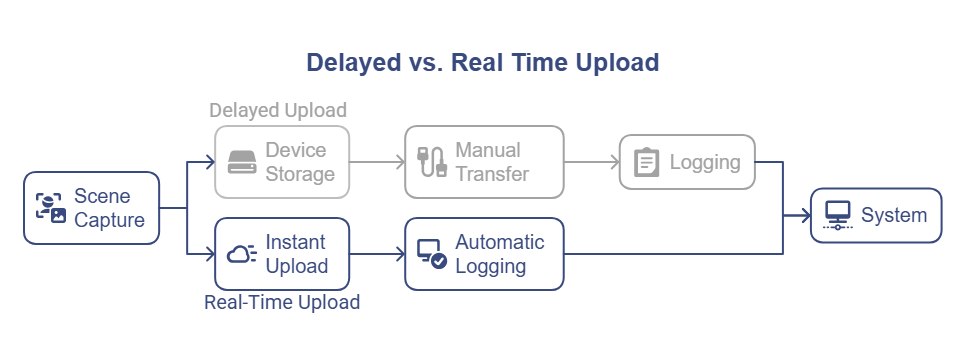
Here is how the two approaches compare across the factors that matter most to law enforcement:
| Factor | Delayed Upload | Real-Time Upload |
|---|---|---|
| Metadata accuracy | Dependent on device and manual input | Captured automatically at collection |
| Chain of custody | Reconstructed after the fact | Built automatically in real time |
| Risk of human error | Higher due to manual steps | Lower with automated transfer |
| Personal device exposure | Still occurs in some departments | Significantly reduced with dedicated tools |
| Connectivity dependency | None at scene | Managed with offline queuing |
| Time to secure | Hours | Seconds to minutes |
The comparison is not about which method is “good enough.” It is about which method reduces exposure and strengthens the case.
So Which Is Better?
Real-time upload is the stronger approach for departments that want to protect their cases, cut administrative burden, and withstand legal scrutiny.
It removes the manual steps that introduce risk. It builds the chain of custody at the moment evidence is created. It secures files before they have a chance to be questioned.
Delayed upload served departments well under older workflows. But the expectations placed on digital evidence today are different. Courts look harder at metadata. Defense counsel scrutinizes the chain of custody more closely. Departments carry more responsibility for how evidence gets handled from the moment it exists.
Real-time upload is better aligned with those expectations than delayed upload.
How VeriPic Supports Real-Time Evidence Collection
VeriPic built EviPad and Witness Upload to close the gap between evidence collection and evidence security.
EviPad gives officers a dedicated field tool that captures and uploads evidence directly into VeriPic’s DEM system. No personal devices. No manual transfers. Fewer gaps in the chain of custody.
Witness Upload extends that same integrity to public-submitted content. Investigators send a secure link, witnesses submit files, and everything lands in the case file with full metadata and chain of custody logging intact.
Together, these features create a closed-loop evidence workflow. Officer-captured and witness-submitted evidence both feed into one secure, auditable system. No manual intervention required.
If you want to map out the full workflow from collection to court, Build a Digital Evidence Workflow That Holds Up in Court is a good next step.
If your department is still relying on delayed upload, it may be time to see what real-time collection looks like in practice.
Request a demo of VeriPic’s EviPad and Witness Upload features.