Bystanders pull out their phones the moment something happens. They record crashes, altercations, fires, and crimes in real time. That footage can solve cases. The problem is getting it into the right hands. In the right format. Without creating documentation gaps along the way.
That is where witness upload software comes in.
The Evidence That Lives on Strangers’ Phones
Modern investigations depend on digital media. Surveillance cameras, body-worn cameras, and dashcams all generate footage. But so do civilians.
Witnesses and bystanders often capture angles that no department camera caught. A neighbor’s doorbell camera. A passerby’s phone video. A business owner’s security feed. That content exists. Getting it into your case file, cleanly and with a clear record of how it got there, is the challenge.
Traditional methods create friction. Investigators ask witnesses to email files, text clips, or bring devices to the station. Those methods can introduce risk. Files can get compressed in transit. Metadata can get stripped depending on how the file is shared. The transfer itself may go undocumented, leaving gaps that are hard to explain later and easy to avoid.
Witness upload software addresses the problem at the point of intake.
What Witness Upload Software Does
Witness upload software gives investigators a way to collect digital media from civilians. At its core, it is a secure upload portal. A browser-based tool. No app download required. No account creation. Witness Upload is part of VeriPic’s broader evidence collection software platform, built into the same environment where investigators manage the rest of their evidence.
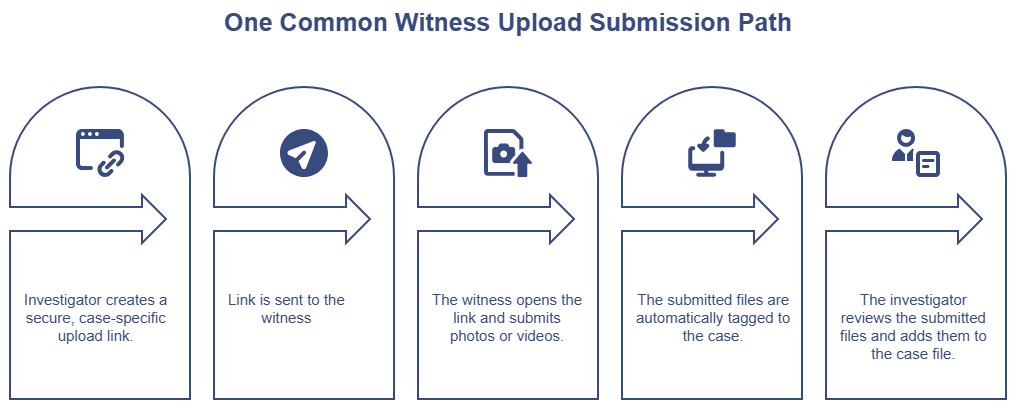
Here is the basic workflow for one common submission path:
- An investigator generates a secure, case-specific upload link.
- The link goes to the witness.
- The witness opens the link on their device and submits photos or videos.
- Files come in tagged to the case and are available for the investigator to review and add to the case file.
Every submission gets logged. The system records when the file was received and which case it was tied to. That intake documentation happens in the background, without anyone lifting a pen.
Why Traditional Collection Methods Fall Short
Investigators have been solving cases without this technology for decades. So why does it matter now?
Volume is one reason. The number of digital files tied to a single investigation has grown. A serious incident can generate hundreds of pieces of media from several sources. Managing that by hand takes time and creates an opportunity for error.
Admissibility is another reason, and the stakes are real. Defense attorneys can challenge digital evidence. That risk grows when the collection process is hard to reconstruct. If an investigator cannot account for how a file traveled from a witness’s phone to the case file, that gap becomes a target. Was it forwarded? Opened on a personal device? Shared before submission?
Courts have raised the bar on digital evidence handling. A well-documented intake record does not guarantee admissibility. That depends on agency policy and how evidence is handled throughout the investigation. But poor documentation is an exposure that is easy to avoid.
Witness upload software addresses both problems. It scales with the volume of modern investigations and creates an auditable intake record from the moment a file is submitted.
How VeriPic’s Witness Upload Feature Works
VeriPic built Witness Upload as a native feature inside its Digital Evidence Management platform. It does not bolt on to an existing system. It lives in the same environment where investigators manage the rest of their evidence.
When an investigator sends a secure link, the recipient does not need to install anything. They open the link in a browser and upload their files. VeriPic logs submission details, including when the file was received and which case it was tied to. No extra handling steps are introduced that could compromise the file.
Witness Upload preserves whatever metadata the file contains on arrival. The intake record is logged consistently regardless of what the file itself contains.
Files come in tagged to the case and are available for the investigator to review and add to the case file. Submissions appear alongside body camera footage, incident reports, and other case evidence. Investigators see it all in one place.
The Chain of Custody Problem It Addresses
Chain of custody is not a formality. It is the documented proof that evidence has not been altered or tampered with between collection and the courtroom.
When a witness texts a video to a detective, that transfer has a timestamp. But it lives in a text thread. Another witness emails a clip. That one lives in an inbox. A third drops off a USB drive. Suddenly an investigator is pulling evidence from several places, hoping nothing got missed. Witness upload software puts all of it in one place from the start.
What the platform controls is the intake record from the point of submission forward. The file is logged, tagged to the case, and stored without added handling steps. Investigators do not need to piece together that part of the transfer later. It was documented from the start.
That intake log is a meaningful advantage over informal methods. For a closer look at what maintaining chain of custody from the moment of capture requires, that framework applies here, too. The goal is the same whether evidence comes from an officer in the field or a witness on the street.
What Departments Are Using It For
Agencies use witness upload portals across a range of case types. A few common applications:
Traffic incidents. Crash scenes often bring out witnesses from several angles. Investigators can collect that footage without visiting each witness or waiting for people to come to the station.
Property crimes. Burglaries and thefts happen in residential areas with neighboring doorbell cameras. A secure upload link makes it easy for neighbors to submit footage without a visit from an officer.
Violent crimes. Investigators working serious cases benefit from rapid media collection. Witness upload software shortens the time between the incident and the evidence submission.
Community-reported events. Some departments use upload links as part of tip lines or community reporting tools. Residents can submit relevant photos and videos without calling a non-emergency line.
In each scenario, the goal is the same. Collect more evidence, faster, with full documentation and no unnecessary handling.
How It Fits Into a Closed-Loop Evidence Workflow
Witness upload software does not work in isolation. It fits into a larger evidence collection strategy.
Within VeriPic’s platform, Witness Upload works alongside EviPad. EviPad is VeriPic’s field-facing mobile evidence collection tool. Officers use it at the scene to capture photos, video, and documentation. Evidence uploads into the DEM system with timestamping and chain of custody logging.
Together, the two tools create a closed loop within VeriPic’s system. Officers document the scene. Investigators collect media from witnesses and the public. Everything flows into one secure environment.
That means investigators do not piece together evidence from several platforms. They work from a single source of record within VeriPic’s platform. Digital evidence collection software supports this kind of end-to-end workflow. The full picture goes beyond any single feature.
What to Look for in Witness Upload Software
Not all solutions approach this the same way. A few things worth evaluating:
No app requirement. Witnesses should not need to download software to submit evidence. Friction reduces participation. A browser-based experience removes that barrier.
Documented intake logging. The system should record when files were received and how they were tied to a case. That should happen without manual documentation from the investigator.
Direct integration with your DEM system. If the upload goes to a separate platform, someone has to transfer it into the case file. That transfer creates a gap. Look for software where the upload and the case file live in the same environment.
Secure, case-specific links. A link tied to a specific case limits access and creates a cleaner record than a general upload portal.
No user-driven handling or manual file transfer steps. Ask whether the system requires any manual action between submission and case association. Fewer steps mean fewer gaps.
The Bigger Picture
Witness upload software is not a replacement for good investigation. It is a tool that helps investigators collect more evidence with less effort and fewer documentation gaps.
The technology exists because the problem exists. Witnesses have evidence. Agencies need that evidence. The handoff has been hard to document cleanly. Informal transfers leave questions that structured intake logging can help answer.
Software addresses the handoff at the point of intake. Investigators send a link. Witnesses submit files. The system handles the intake documentation.
If your agency relies on email threads, personal devices, or manual logging to collect witness media, that process carries risk. Defense attorneys can point to those gaps. Purpose-built evidence collection software removes unnecessary handling. It starts building the evidentiary record the moment a file arrives.
VeriPic’s Witness Upload feature is built into the VeriPic Digital Evidence Management platform. Witness and public submissions are tagged to the case. Investigators can review and add them to the case file. Intake is logged from the point of submission. Learn more about how VeriPic supports end-to-end evidence collection.