An officer photographs a crime scene on a phone. The images land in the camera roll. The case goes to trial. Defense counsel starts asking questions about the chain of custody. The agency has no documentation for the gap between capture and upload.
The problem is not the device. It is where the photos go the moment the shutter closes. For agencies evaluating evidence collection software, uncontrolled capture workflows create chain of custody risk. That risk can go undetected until a case is already in jeopardy.
Here is what you need to know.
The Core Problem: Evidence That Lives Outside the System
When an officer captures a photo on a phone, that image lands in a camera roll. It exists outside the evidence management system entirely. There is no case file entry. There is no timestamp tied to the investigation. There is no access log. No record exists of who could view it, share it, or modify it before someone uploads it manually.
That window is the problem.
It does not matter whether the phone is owned or agency-issued. What matters is whether the evidence went into a controlled system at the moment of capture. If it did not, the chain of custody starts with a gap.
What Happens in That Gap
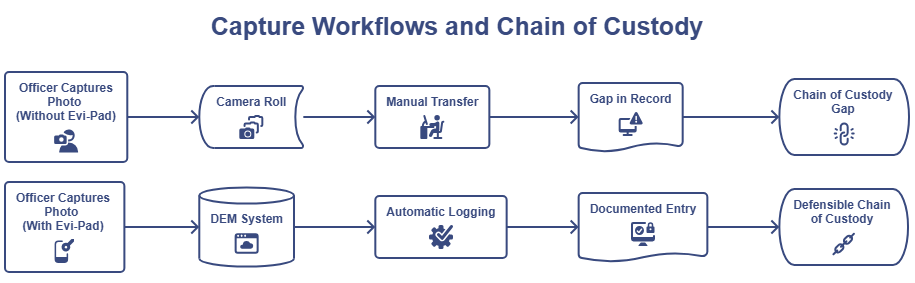
A photo in a camera roll is an uncontrolled file. Several things can happen before it reaches the case management system, and each one affects its evidentiary value.
Metadata can be lost or altered. Photos transferred through a text message, email, or manual upload may lose their original metadata. The capture timestamp may shift to the transfer timestamp. GPS coordinates can be stripped. The record of which device captured the image can disappear. What arrives in the case file may look like evidence, but its origin is no longer verifiable.
Access goes untracked. A photo sitting in a camera roll is accessible to anyone who picks up that phone. No log captures who viewed it, who shared it, or whether someone edited it before upload. In court, that absence of documentation becomes a question the agency has to answer.
Manual transfers introduce human error. Officers handling their own uploads may miss files, upload duplicates, or transfer images out of sequence. None of that gets flagged automatically. The case file may be incomplete without anyone knowing it.
Why This Creates Discovery Exposure
When defense counsel questions photographic evidence, chain of custody is the first place they look.
A photo with a timestamp that does not match officer reports raises questions. Missing GPS metadata raises questions. An upload date that falls days after the reported capture date raises questions. Each inconsistency gives defense counsel an opportunity to challenge the evidence.
Courts apply a relevance and proportionality standard to discovery. If a party can show the official record may be incomplete, they may seek to examine how that evidence moved before it entered the system. Full device access is not automatic. There is often a legal fight first. Courts may limit the scope of what gets produced. But the documentation gap is what creates the opening.
The agencies that avoid that exposure are the ones that never created the gap.
The Chain of Custody Problem Starts at Capture
Chain of custody is not just about where evidence goes after it enters the system. It starts the moment evidence gets documented.
When a photo lands in a camera roll instead of a case file, the chain of custody does not start. It gets reconstructed later, after the fact, based on whatever the officer can account for. That reconstruction is not the same as documentation. Prosecutors may need to account for every step in the chain. That includes how evidence moved from the scene to the file. A camera roll introduces a step that no agency system recorded.
That step becomes a potential line of attack.
For more on how to protect the chain from the first moment of capture, see How to Maintain Chain of Custody from the Moment of Capture.
Why Policy Alone Fails Without Proper Evidence Collection Software
When a capture workflow requires manual uploads after the fact, the camera roll becomes a default holding point. That happens even when policy says otherwise. The gap is structural. Agencies relying on informal workflows carry that structural risk into every case.
The fix is making the right tool the easiest tool. That is the core argument for purpose-built evidence collection software over informal capture workflows.
When the capture tool and the evidence system are the same tool, the camera roll problem disappears. The officer takes the photo. It goes into the case file. The timestamp, GPS coordinates, and officer credentials log without any manual steps. Nothing sits in a camera roll waiting for a transfer that may alter the metadata.
That is what VeriPic’s Evi-Pad does. Officers capture photos, video, and audio at the scene. Evidence uploads into the DEM system. Timestamping, GPS metadata, and chain of custody logging happen without manual intervention. It never touches the camera roll. There is no gap between capture and documentation.
What Happens When the Public Submits Evidence
The camera roll problem is not limited to officer-captured evidence. Investigators collect photos and videos from witnesses and members of the public. Digital evidence collection software addresses this at the system level, not the policy level.
A photo sent through a text message or email passes through multiple points before it reaches a case file. Metadata can be lost, stripped, or modified depending on the transfer method. No automatic log ties the submission to the chain of custody. The agency receives a file with an undocumented origin.
A controlled submission process eliminates that gap. VeriPic’s Witness Upload feature sends a secure link to the witness. They submit photos or video from their own device without downloading an app. Each submission logs with metadata and ties to the chain of custody. The agency receives the file into the system, not through an investigator’s inbox.
To understand the full picture of how purpose-built tools replace informal workflows, see Digital Evidence Collection Software for Police.
Closing the Gap Before It Becomes a Problem
Agencies that wait for a chain of custody challenge are already behind.
The risk does not start in the courtroom. It starts the moment a photo lands in a camera roll instead of a case file. Every image outside the evidence system carries an undocumented origin. The chain of custody is unverifiable. That gap gives defense counsel an opportunity to question the integrity of the entire record.
The agencies that reduce that exposure are the ones that closed the gap at the source.
That means capture tools that feed into the evidence system. It means chain of custody logging from the moment of capture. And it means submission workflows that keep evidence out of camera rolls and personal inboxes entirely.
For a broader look at how modern agencies are rethinking their approach, see How Agencies Are Rethinking Their Evidence Collection Equipment.
This post is for informational purposes only and does not constitute legal advice. Discovery standards and evidentiary rules vary by jurisdiction and the specific facts of each case.
Whether a photo in a camera roll can create a chain of custody problem has a clear answer. The more important question is whether your agency has eliminated the conditions that make it possible.