Evidence collection software exists to solve one of law enforcement’s most persistent problems. Evidence touches a dozen hands before it reaches the courtroom. Officers capture photos at a scene, witnesses submit video from their phones, detectives pull footage from a third source, and every handoff creates risk. In court, that risk can weaken admissibility or complicate prosecution.
This post walks through what a unified evidence collection software workflow actually looks like, where the gaps tend to appear, and how agencies are closing them before cases go sideways.
Why Fragmented Evidence Collection Creates Legal Risk
Law enforcement agencies have always collected evidence from multiple sources. What changed is the volume. Smartphones, doorbell cameras, dashcams, and body-worn devices have created an explosion of digital media. Agencies that were not built to handle that volume are feeling the strain.
The result is a patchwork approach. Officers email photos to themselves. Witnesses upload videos to personal cloud accounts. Detectives drag files between folders and rename them by hand. Every manual step introduces a new opportunity for error.
Chain of custody is supposed to document who touched the evidence and when. But when evidence moves through personal devices, email threads, and shared drives, that documentation becomes nearly impossible to reconstruct cleanly. Defense attorneys know exactly where to look for those gaps.
Where the Evidence Collection Workflow Breaks Down
Most agencies can point to at least one of three common breaking points.
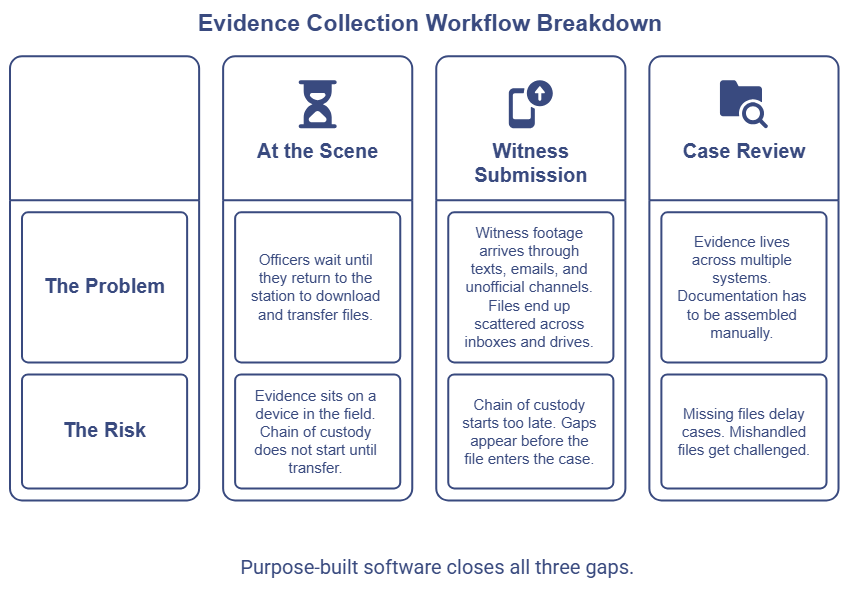
The first happens at the scene. Officers wait until they return to the station to download and transfer files. Evidence sits on a device in the field. Chain of custody does not start until transfer.
The second happens with witness submissions. A detective asks a witness to send over footage. The witness texts it, emails it, or uploads it to a file-sharing app. That file lands in a personal inbox or a general folder. Someone has to manually sort it, verify it, and attach it to the case. Chain of custody documentation starts too late. Gaps appear before the file enters the case.
The third happens during case review. When a prosecutor or defense attorney needs to review evidence, someone has to pull it together. Evidence lives across multiple systems. Documentation has to be assembled manually. Missing files delay cases. Mishandled files get challenged.
Each breaking point compounds the others. A case with fragmented evidence is harder to prosecute, easier to challenge, and more expensive to manage.
What Chain of Custody Actually Requires from Your Evidence Collection Process
Chain of custody is not just a best practice. It is a key evidentiary requirement. Courts require agencies to demonstrate that evidence was collected, stored, and handled in a way that preserves its integrity.
That means documenting who collected the evidence, when, and where. It means logging every access point, every transfer, and every person who touched the file. It means showing that the file was not altered between collection and presentation.
A manual process can meet that standard if executed carefully. In practice, human error, time pressure, and system limitations make gaps nearly inevitable. And once a gap appears in the chain of custody, the integrity of the evidence is in question.
Purpose-built evidence collection software can enforce these requirements automatically. When a system logs every upload, access, and transfer without requiring officer intervention, key chain of custody events document themselves. That is a meaningful shift.
What a Unified Evidence Collection Software Workflow Looks Like
A unified workflow does not mean one device or one step. It means one system. Evidence can originate from the field, from the public, or from third-party sources. What matters is where it lands.
When all evidence feeds into a single platform, a few things happen automatically. Metadata is captured at the point of collection and preserved. Chain of custody logging begins the moment the file enters the system. Every access is recorded. Every transfer is tracked.
Prosecutors can pull a complete, documented evidence package. The system helps reduce handling gaps by automatically documenting uploads, transfers, and access activity. The case is easier to build and harder to challenge.
Getting there requires two things: a field collection tool that reduces manual transfers, and a public submission tool that captures witness evidence without routing it through unofficial channels.
Closing the Field Gap with Mobile Evidence Collection Software
Evi-Pad™, VeriPic®’s field-facing mobile evidence collection tool, addresses the first part of that equation. Officers use it at the scene to capture photos, video, and documentation. That media uploads directly into VeriPic’s Digital Evidence Manager® from the field.
There are fewer manual transfers. No waiting until officers return to the station. No renaming files or attaching them through email. The moment an officer captures the evidence, the system logs it with timestamping and chain of custody documentation tied to the capture event.
For the officer, the process is simple. Capture it and move on. For the detective reviewing the case, the evidence is already in the system, already documented, and already tied to the chain of custody. Nothing has to be reconstructed after the fact.
Closing the Public Submission Gap with Witness Upload
Witness Upload™ handles the second part. When an investigator needs footage or photos from a witness or a member of the public, they send a secure link. The recipient submits their media directly from their own device. No app download required.
That submission lands in an unassigned folder inside VeriPic’s Digital Evidence Manager, where the detective can review and assign it to the correct case. The system logs submission details and ties the file to the chain of custody automatically. The detective never handles the file through a personal inbox or a shared drive. The file moves from the witness’s device into the Digital Evidence Manager without touching unofficial channels.
This matters in court. When a defense attorney asks how witness footage was obtained and handled, the answer is clean. The system preserves the original submission and documents all access and handling activity from the moment it enters the Digital Evidence Manager.
One Evidence Collection Software System, One Record
Together, Evi-Pad and Witness Upload create a closed loop. Evidence from the field and evidence from the public both feed into the same secure platform. Both are documented the same way. Both meet the same chain of custody standard.
When a case goes to court, the prosecutor works from one complete record. Every piece of evidence is logged, timestamped, and traceable. There are no side channels to explain, no gaps to account for, and no transfers to justify.
Agencies using VeriPic’s Digital Evidence Manager can pull an audit trail that shows the full life of the evidence. Where it was captured. Who accessed it. When. From what device. That level of documentation helps agencies support evidentiary requirements and demonstrate proper handling from the moment evidence was collected.
The Real Cost of Fragmented Evidence Collection
Fragmented evidence collection workflows are not just inconvenient. They carry real costs. Cases get challenged. Detectives spend hours reconstructing transfers that should have been automatic. Prosecutors request documentation that does not exist or that has to be assembled by hand.
And then there are the cases that do not make it to trial at all, because the chain of custody cannot be established cleanly enough to move forward.
Agencies that invest in unified evidence collection software are not just solving an operational problem. They are protecting the integrity of their investigations. They are giving prosecutors the documentation they need and giving courts the confidence that evidence was handled properly from the moment it was collected.
That is what a unified workflow delivers. Not a single device. Not a single step. A single system that documents everything, from the field and from the public, all the way to the courtroom.
Want to see how it works? Request a demo of VeriPic’s evidence collection software and walk through the full workflow from field capture to case file.