Why Witness Video Collection Needs a Better System
Evidence collection software exists for a reason. Most agencies collect witness video through email. That creates real problems.
File size limits prevent large video files from being uploaded. Witnesses compress footage to make it fit. Quality drops. Cloud links expire. Account logins stop witnesses cold. Follow-up stretches into days. The video that could close your case sits in someone’s personal inbox, undocumented.
Purpose-built digital evidence collection software solves this. The right platform is often referred to as a Digital Evidence Management System, or DEMS. It gives investigators a secure, auditable way to collect witness media. It removes the friction that informal methods create.
This post covers where email falls short. It explains what reliable evidence intake requires. And it shows how modern evidence collection software closes the gap.
Why Witness Video Has Become Central to Investigations
Ten years ago, bystander footage was a bonus. Today, it is often central to the investigation.
Witnesses record incidents in real time. They use mobile phones, dashcams, and security systems. CCTV footage and mobile phone video capture details that no officer on scene could document. They fill gaps. They corroborate statements. In some cases, they are the case.
But if collected poorly, that footage can lose value fast.
Courts scrutinize how digital evidence is collected, preserved, and documented. Chain of custody requirements apply to video files just as they apply to physical items. You need to show when a file was submitted. You need to show how your agency handled it. Without that, opposing counsel has room to challenge admissibility in court.
That challenge does not guarantee exclusion. But weak documentation creates risk. A clean intake process removes that risk early.
Why Email Fails as a Digital Evidence Transport Method
Email was not designed for evidence intake. Some agencies make it work. They document intake with care. They log the chain of custody after receipt. They apply consistent handling practices.
The problem is that few do all of that.
In practice, email-based collection looks like this. A witness sends a file to a department address. An investigator downloads it to a local machine. They rename it, move it to a case folder, and log it by hand. At each step, there is room for error or missing documentation.
Forwarding, exporting, cloud-sharing, or re-uploading files can alter metadata. They can recompress media or strip original file attributes. A video with original GPS and timestamp data may arrive with that data missing or changed. That creates questions a well-logged submission would not raise.
The problem is not the transport method itself. The issue is what happens, or does not happen, around it. For a closer look at how the two approaches compare, see Witness Upload vs. Email Attachments: Which Works Better for Evidence Collection?
Email vs. Purpose-Built Evidence Collection Software: A Side-by-Side Look
| Factor | Email-Based Collection | Evidence Collection Software |
|---|---|---|
| File size limits | Common: videos often exceed limits | Handled by the platform |
| Metadata preservation | Depends on workflow: can be lost or altered | Kept during intake |
| Chain of custody logging | Manual: relies on investigator | Logged by the system |
| Witness friction | High: steps, logins, or app installs | Low: single link, no account needed |
| Investigator workload | High: manual download, rename, upload, log | Low: submissions routed to review queue |
| Documentation consistency | Variable by investigator | Consistent across all submissions |
Key Capabilities of Reliable Evidence Collection Platforms
Purpose-built evidence collection software addresses the gaps that informal methods leave behind.
A reliable platform does four things well.
Documented submission metadata and upload attribution. The system captures submission details at the moment of upload. No manual logging. No investigator relying on memory to record when a file arrived and from where.
Direct chain of custody logging. From the moment a witness submits, the file moves into the evidence management system. No intermediary inboxes. No manual transfers between accounts.
File integrity during intake. The platform preserves submitted files without compression or format conversion. No quality loss from re-uploading through other platforms.
Low friction for witnesses. A complicated process means witnesses will not complete it. A single-step upload with no app download and no account creation drives higher completion rates. Witnesses can also submit without identifying themselves. That lowers barriers for those reluctant to come forward.
These are not premium features. They are the baseline for a defensible evidence intake process.
How Secure Witness Portals Work in Practice
The workflow is simple. An investigator sends a secure link to a witness via text or email. The witness clicks the link and reaches an upload page. No app download. No account creation. No login required. They select their files and submit.
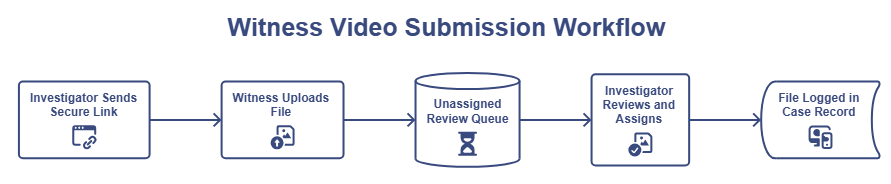
The submission routes to an unassigned review queue. It does not go into a case file right away. An investigator reviews the submission and assigns it to the right case. The system logs submission metadata throughout. The workflow runs the same way every time.
VeriPic’s Witness Upload feature works exactly this way. Investigators send a secure link from within the DEMS platform. The witness submits from any device. Submissions route to a review queue with full metadata and intake logging. The investigator reviews the file and assigns it to the case record. No email required. No manual transfer.
That documentation record matters when opposing counsel asks about admissibility. Investigators can point to a complete, system-generated log. It shows how the evidence was collected, reviewed, and assigned. No reconstruction from memory required.
The Operational Benefit Beyond the Courtroom
Secure digital evidence collection also makes investigators more efficient.
Think about the time your team spends chasing witness submissions. Following up on failed email attempts. Re-sending requests. Downloading files from personal inboxes. Uploading them to case management systems by hand. Renaming files. Logging metadata by hand.
Every one of those steps is a delay. Every manual entry is a potential error.
A secure witness upload portal eliminates that loop. The investigator sends one link. The witness submits. The file routes to the review queue. The investigator reviews, assigns, and moves on.
For high-volume investigations or cases with several witnesses, that efficiency compounds. Less administrative overhead means more time on investigative work.
How Evidence Collection Software Fits Into Your Digital Evidence Workflow
Adopting purpose-built evidence collection software does not require a complete workflow overhaul. It requires the right tool and a clear intake procedure.
Start by identifying where your current process breaks down. Investigators using personal email accounts or shared inboxes are your first risk area. Define a standard process for issuing witness upload requests. Use a digital evidence management platform that sends the secure link and routes submissions to a review queue. Investigators need a documented path for assigning files to the case record.
Train investigators to send the link early. Do not wait until the witness has already tried to email you. Get them into the right system from the first contact.
Document the process. A repeatable evidence collection workflow supports your cases across the board.
The Documentation Standard Is Rising
Courts are paying more attention to how digital evidence is collected and documented. Defense attorneys understand metadata. They understand the chain of custody. They know what questions to ask about how digital files are moved from submission to case record.
Departments that rely on informal methods may find those methods hold up fine. Or they may face challenges that a structured process would have prevented.
Purpose-built evidence collection software does not guarantee admissibility in court. No tool does. But it reduces documentation gaps that create unnecessary exposure. And it saves investigators the time and effort that informal methods demand.
If your department still collects witness video through email without a formal intake process, ask whether that workflow can hold up under scrutiny.
Frequently Asked Questions About Evidence Collection Software
What is evidence collection software?
Evidence collection software is a digital platform for law enforcement. It allows agencies to gather, log, and manage evidence from investigators and the public. It reduces reliance on informal methods like email. Submissions tie to a structured, auditable intake process in a case management system.
Is email secure enough for witness video collection?
Email can work with strong documentation and intake logging practices. Most agencies lack that structure. Without it, manual steps create gaps. Downloading, renaming, re-uploading, and logging by hand introduce errors that purpose-built tools avoid by design.
How do police collect witness videos securely?
Secure witness video collection uses a link-based submission portal. An investigator sends a secure link to the witness. The witness uploads from their device. No app download needed. Witnesses can submit without identifying themselves. The file routes to a review queue. An investigator assigns it to the case. The platform logs submission metadata and intake records throughout.
What metadata should be preserved in digital evidence?
The metadata that matters varies by case and jurisdiction. In general, preserve original submission details, timestamps, and file attributes. This supports authentication and chain of custody documentation. Workflows with several downloads, re-uploads, or format conversions carry the highest risk of metadata loss or alteration.
Does evidence collection software support chain of custody?
Yes. Purpose-built evidence collection software generates intake and handling logs at the moment of submission. Those logs document how evidence entered the system. They show how an investigator reviewed and assigned each file. They support chain of custody documentation throughout the case lifecycle.
What is a witness upload portal?
A witness upload portal is a secure, link-based submission page. Members of the public use it to submit photos and videos to law enforcement. No app download or account creation needed. Witnesses can submit without identifying themselves. Files route to a review queue where investigators assign them to the right case record. The platform logs metadata throughout.
VeriPic’s Witness Upload feature gives investigators a secure, link-based way to collect witness photos and videos. Submissions route to a review queue with full metadata and intake logging. Investigators review and assign files to the case record. No app download required. Learn more about how VeriPic’s Digital Evidence Management platform supports the full evidence lifecycle.